
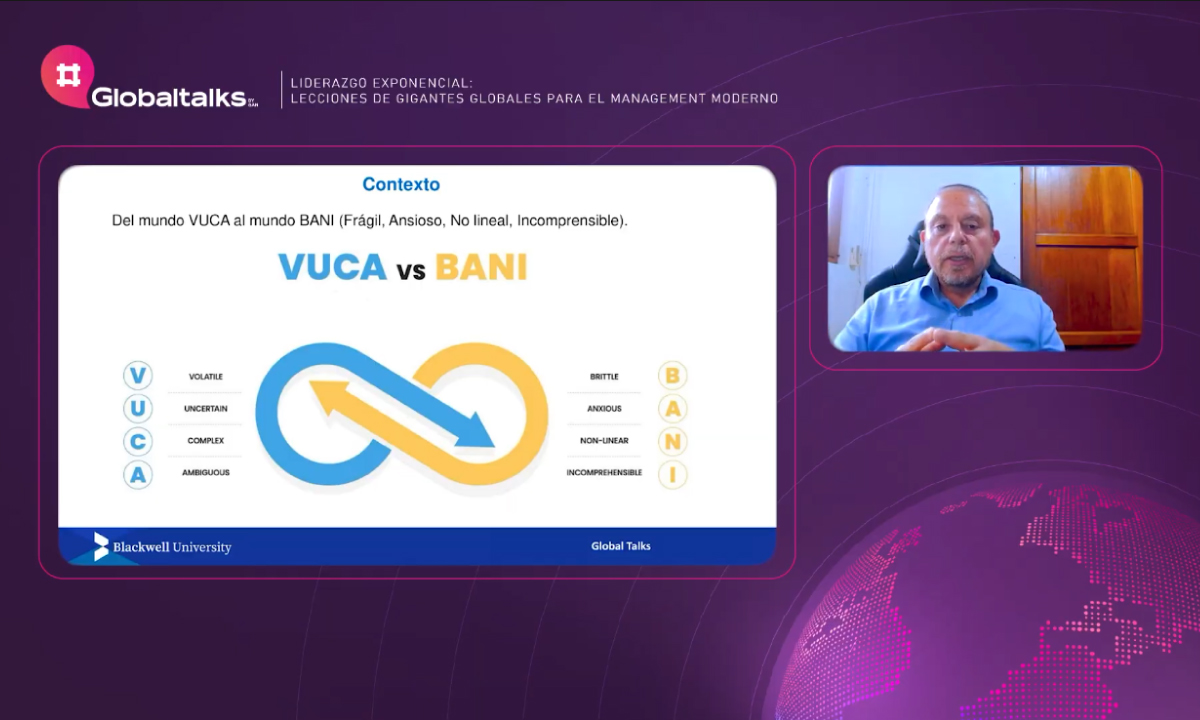
In the latest edition of #GlobalTalks, an international conference series powered by the Global Academic Network (GAN), the conversation regarding the future of work took a profound turn toward the human element. PhD. MBA Jorge Luis Javier Vidalón, a distinguished scholar from Blackwell Global University, delivered a compelling presentation titled "Exponential Leadership: Global Lessons for Modern Management." His core thesis argues that as Artificial Intelligence (AI) scales exponentially, the most critical "technological" asset an organization possesses is no longer its code, but its empathy.
Navigating the BANI World Through a Humanist Lens
Dr. Vidalón explained that the traditional VUCA model has evolved into what experts now call the BANI world—an environment characterized by being Brittle, Anxious, Non-linear, and Incomprehensible. In this fragile landscape, traditional linear management styles often fail because they lack the emotional agility required to handle systemic anxiety. According to Vidalón, the exponential leader must adopt a "Humanist" mindset, ensuring that every strategic decision positively impacts people and communities.
By shifting from a control-based hierarchy to an "orchestrator" role, leaders can foster an environment where teams feel safe to innovate. Dr. Vidalón emphasized that overcoming "organizational immunity to change"—the subconscious sabotage of new initiatives—requires more than just new software; it requires a culture of trust. This human-centric approach allows organizations to scale 10X by leveraging the collective intelligence of their talent rather than relying solely on incremental technical adjustments.
Empathy: The Most Strategic Capability of the 21st Century
One of the most provocative points of the conference was the redefinition of empathy. Dr. Vidalón posited that in the age of automation, empathy has transitioned from a "soft skill" to the most strategic technological competency of the human factor. While machines excel at processing vast amounts of data, only humans can decode the deep motivations and emotions of a user. This understanding is what truly drives "Massive Transformative Purpose" (MTP), the fuel behind global giants like Tesla and Patagonia.
Referencing Microsoft’s cultural transformation under a "Growth Mindset," Vidalón highlighted how learning and adaptability have replaced the "know-it-all" culture. The leader’s paradox involves managing the present—exploitation—while simultaneously exploring the future. To balance these tensions, Vidalón quoted Nelson Mandela, reminding the audience that a leader should "lead from behind" during times of success but take the "front line" when danger arises. This vulnerability and presence are what build lasting loyalty in an increasingly digital world.
Blackwell Global University’s Vision for Future Directors
As the session concluded, Dr. Vidalón urged students and executives to develop a "sense of urgency" regarding their own upskilling and reskilling. The ability to formulate the right questions rather than just providing answers is what distinguishes an exponential leader from a traditional manager. Blackwell Global University continues to spearhead this educational shift, preparing students not just to use technology, but to lead the humans who create it.
The final takeaway from Global Talks was clear: "Linearity is a risk; exponentiality is the new norm". By integrating high-tech tools like AI with high-touch human skills like empathy, modern organizations can build business models designed for the 21st century. As Peter Drucker famously said, "The best way to predict the future is to create it," and according to Dr. Vidalón, that future must be inherently human.












No comments yet. Be the first!