
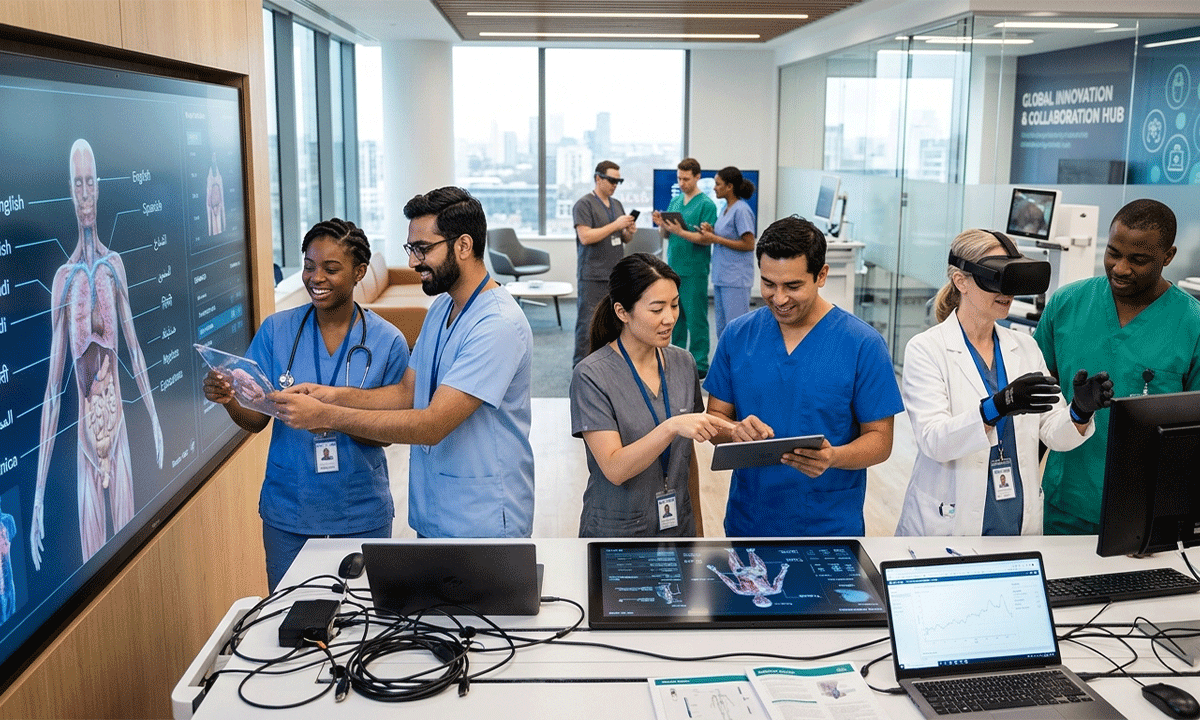
Artificial intelligence is no longer an emerging concept in healthcare—it is actively influencing how diagnoses are made, how treatments are planned, and how health systems operate. This shift is now extending into education, forcing institutions to reconsider how healthcare professionals are trained in an increasingly data-driven environment.
According to the World Economic Forum, nearly 44% of healthcare skills are expected to change by 2030 due to technological adoption, with artificial intelligence playing a central role. This transformation is not limited to technical specialists; it affects doctors, nurses, administrators, and public health professionals alike.
Signals of a structural shift in professional training
Healthcare education has traditionally focused on clinical expertise, patient care, and evidence-based practice. While these remain essential, the integration of artificial intelligence introduces a new layer of complexity: professionals must now understand how algorithms influence decision-making processes.
This signals a broader transformation in higher education. Learning is becoming more interdisciplinary, combining medical knowledge with data literacy, digital tools, and strategic thinking. Institutions that fail to adapt risk producing graduates who are unprepared for modern healthcare environments.
New opportunities emerging from AI integration
As artificial intelligence becomes embedded in healthcare systems, new professional pathways are emerging. These include roles in clinical data analysis, digital health project management, AI implementation, and healthcare innovation strategy.
This shift also expands career mobility. Professionals who acquire AI-related competencies can transition across sectors, from hospitals to health tech companies, research institutions, and policy organizations. The ability to operate at the intersection of healthcare and technology is becoming a defining advantage.
How education systems are responding
Educational institutions are beginning to design programs that reflect these evolving demands. Rather than focusing solely on theoretical knowledge, they are integrating applied learning experiences that simulate real-world challenges.
The Advanced Certificate in Artificial Intelligence for Healthcare Professionals offered by the Division of Continuing Education of Blackwell Global University exemplifies this approach. It combines practical frameworks with strategic understanding, enabling learners to engage with AI technologies in clinical and organizational contexts.
A long-term shift in how professionals learn
The rise of artificial intelligence in healthcare reflects a deeper transformation in global education: the shift toward continuous, skills-based learning. Professionals are no longer defined by a single degree, but by their ability to adapt and update their competencies over time.
For educators and institutions, the challenge lies in designing programs that remain relevant in fast-changing environments. For learners, the priority is clear: developing hybrid skill sets that combine domain expertise with technological fluency will be essential to remain competitive in the global workforce.








No comments yet. Be the first!